Close announcement bar
Alert
Notice
Online forms will be unavailable from 3am to 7am on Thursday, 22 October while we complete some essential maintenance. The website will also go down for approximately five minutes at some point between these times.
If you need to report a crime during this time, please call us on 101, or 999 in an emergency.

Crime and intelligence - Live Facial Recognition procedure (S5101)
1. Summary of change
1.1 This joint Kent and Essex procedure has been developed from Essex only procedure.
2. What this procedure is about
2.1 This procedure explains the standard procedures to be adopted when planning for, using, and reviewing the use of Live Facial Recognition.
2.2 This LFR procedure document provides Kent Police and Essex Police personnel with advice on the overt use of LFR in a legally compliant and ethical manner to enable both forces to achieve legitimate policing aims.
2.3 This procedure document has been written with consideration to the views of the Information Commissioner, Biometrics and Surveillance Camera Commissioner, national guidance, academic based testing and a code of practice relating to LFR and its use by UK Law Enforcement Agencies (LEA).
2.4 This procedure is particularly aimed at (this list is non-exhaustive):
- All operational officers and staff, and their supervisors involved in the planning and deployment of LFR.
- All officers and staff involved in any subsequent investigation resulting from the operational deployment of LFR technology.
- All authorising officers (AOs)
- All officers applying for the deployment of LFR.
- The operational command team for LFR deployment (Gold, Silver and Bronze)
- LFR operators, LFR engagement officers and LFR system engineers.
Compliance with this policy and any linked procedures is mandatory.
3. Detail the procedure
3.1 Terminology
3.1.1 This procedure focuses exclusively on LFR. Terminology relating to LFR is defined in the Kent Police and Essex Police LFR Policy Document.
3.2 Aim and Scope of Procedure
3.2.1 This procedure aims to:
- Provide Kent Police and Essex Police personnel with information about the strategic and operational objectives of the overt use of LFR.
- Provide Kent Police and Essex Police personnel with guidance on the deployment of overt LFR technology by either force in spaces accessible to the public to meet their respective policing objectives for LFR.
- Establish the governance structure for the deployment of LFR, ensuring that the use of LFR by Kent Police and Essex Police is appropriately governed and legally compliant.
- Provide an overview of LFR technology and advise on practical issues such as camera selection and placement to obtain the best performance from the LFR system.
3.3 Legislative Compliance
3.3.1 This document has been drafted to comply with the principles of the Human Rights Act 1998. It pays particular attention to the duties of the force regarding privacy and the rights to assembly, thought and expression.
3.3.2 Equality and Diversity duties and issues have been considered, and this is reflected in the Equality and Wellbeing Impact Assessment that is provided alongside this document.
3.3.3 As with all policies, the duties and obligations of the force regarding Data Protection, Freedom of Information and Health and Safety matters have been considered and complied with, along with the College of Policing’s Authorised Professional Practice (APP) on Facial Recognition Technology.
3.4 Strategic objectives
3.4.1 LFR deployments must comply with the following strategic objectives:
- Use overt LFR technology in a responsible and proportionate way to locate offenders in accordance with the common law policing powers of Kent Police and Essex Police. This includes targeting those wanted for criminal offences, those who pose a risk of harm and those wanted by the courts.
- Use LFR to protect life and property, preserve order and prevent threats to public security, prevent and detect crime, bring offenders to justice, and uphold national security. This includes targeting those wanted for offences. It also includes using LFR technology to protect the public and reduce crime.
- Strengthen and develop LFR technology capability to protect the public, reduce serious crime, help safeguard vulnerable persons including missing people and children, and keep the communities of Kent and Essex safe.
- Build public trust and confidence in the development, management, and use of LFR by taking account of privacy concerns and maximising transparency.
- Maintain good governance through a command structure that incorporates strategic, operational, and technical leads for the deployment of LFR, with clear decision making and accountability.
- Ensure that the deployment of LFR is used in compliance with all applicable legal requirements, and that it meets the oversight and regulatory framework as presently outlined in England and Wales by relevant regulators, national guidance and Kent Police and Essex Police LFR documents.
- Transparently identify, manage and mitigate reputational and organisational risk to Kent Police and Essex Police.
- Be recognised as a progressive, responsible, and ethical organisation.
3.5 Authority to Deploy LFR
3.5.1 There are ten stages of deployment which consist of the following:
- STAGE 1 - Departmental/LPA identification of potential LFR deployments
- STAGE 2 - Check availability of LFR vans via the LFR webpage.
- STAGE 3 - Local or Force Tasking bid if required.
- STAGE 4 - Complete LFR Application on CHARTER software.
- STAGE 5 – CAB will quality assure the application and send to the authorising officer.
- STAGE 6 - Authorising Officer assessment of application and authority.
- STAGE 7 - Public notification of deployment via media department (five working days prior)
- STAGE 8 – Notification of deployment to the PFCC and ACC, Serious Crime Directorate.
- STAGE 9 - Populating the watchlist (including PND searches)
- STAGE 10 - Deployment of LFR technology
3.5.2 In normal circumstances, authority to deploy LFR must be granted by a trained and designated LFR Authorising Officer (AO), normally of Superintendent rank or above. The authority is attached to the designated AO role, relevant training and force-approved authorisation route, not to rank alone. LFR applications should be submitted and authorised through the agreed CAB/CHARTER process.
3.5.3 The Kent Police and Essex Police LFR Application / Authority Document recognises that the intelligence case for the use of LFR may give rise to a single deployment, or a need for a series of deployments within a time-limited period. All applications are to be written and authorised within the CHARTER system software.
3.5.4 In Kent Police and Essex Police an Authorising Officer may authorise the use of LFR based on one application for a period of up to 7 consecutive days. An authority can be granted for separate days over a period of time if the intelligence case and legitimate policing aim is met.
3.5.5 The application combined with the authorising document provides for a baseline of safeguards to ensure that the need for the deployment and the currency of the watchlist continues to be maintained with due oversight.
3.5.6 Should the need to deploy continue beyond 7 days, a further Kent Police and Essex Police LFR Application will be submitted, and a further authority would be granted if, in the AO’s view, the conditions for deployment continue to be met.
3.5.7 This approach ensures that the use of LFR is time limited but allows an operationally effective way to plan for and deliver LFR as part of wider Kent Police and Essex Police crime-fighting strategies.
3.5.8 A Chief Officer does not provide authority for LFR deployment. However, in some instances the AO may seek to consult with the Chief Officer regarding the specific circumstances of a particular deployment if it falls outside of normal deployment parameters, for example the use of an image of a child under the age of 13yrs, circumstances in line with 3.8, 3.10, 3.28. This allows the Chief Officer the opportunity to consider the circumstances and either veto the deployment or ask the AO to consider any mitigation that may be required to address the concerns at hand.
3.5.9 The AO must notify the relevant Police and Crime Commissioner, or designated deputy, and the appropriate Chief Officer lead prior to any deployment.
3.5.10 Where the AO is not immediately able to provide their authority in writing and the request is urgent, such authority may be given verbally. The time of this verbal authority must be recorded by both the applicant and the AO. Written authority must then be recorded as soon as is practicable.
3.5.11 Urgent deployments are defined as those where a delay in deployment in order to complete a written application and authority documents would place people or property at serious risk of harm or be a risk to national security; or
3.5.12 An intelligence or investigative opportunity with limited time to act, the seriousness of which and the benefit of deployment justifies urgent action.
3.5.13 The AO must consider and document the below, including the objective pursued, why LFR will help achieve it, why less intrusive methods are insufficient, why the anticipated benefits outweigh the privacy impact, and why the chosen location, duration and watchlist are proportionate:
- The legitimate policing aim of the deployment and the legal powers that are being relied upon to support the deployment and
- That the AO is satisfied that the deployment complies with this procedure, Kent Police and Essex Police policy and other relevant LFR documentation, including legal mandate and EIA; and
- Articulate that the processing of sensitive personal information is strictly necessary for a law enforcement purpose as defined by the Data Protection Act 2018.
3.5.14 The AO must be satisfied that there is a ‘pressing social need’ for the deployment and it is not reasonably viable to address this through less intrusive means, either because less intrusive methods have tried and failed or because there are reasonable grounds to believe that such tactics are unlikely to be effective.
3.5.15 Necessary on at least one of the following grounds:
- Necessary for the lawful policing purposes of Kent Police and Essex Police for reasons of substantial public interest; and / or
- Necessary for the administration of justice and / or
- Necessary for the safeguarding of children; and / or individuals at risk; and
- Necessary notwithstanding any expectation people may have pursuant to their article 8 human rights regarding the respect of private and family life, as well as other human rights considered by the AO; and
- Articulate that the AO has given due regard to the safeguards proposed for the deployment and the safeguards contained within the Kent Police and Essex Police LFR suite of documents. Having given due regard to such safeguards, the AO must consider that the deployment is a proportionate use of policing power when balancing the intended use against considerations relating to the Human Rights Act 1998, the Data Protection Act 2018 and UK GDPR; and
- Outline that the AO is satisfied that all reasonable steps have been taken to ensure that the composition of the watchlist complies with the Kent Police and Essex Police LFR suite of documents, including the legality, necessity and proportionality criteria; and
- Direct that all officers and staff engaged in the deployment must have received LFR training in accordance with the Kent Police and Essex Police LFR documents, unless they have received comparable training delivered by another UK police force.
3.5.16 Articulate that the AO considers the benefits of the deployment are proportionate to the impact on the public’s human rights and rights relating to equality.
3.5.17 Articulate that the AO is satisfied that the control measures in the data protection impact assessment, community impact assessment and equality impact assessment have been reviewed and that the AO considers them to be appropriate mitigations for the deployment.
3.5.18 Articulate the AO’s minimum threshold setting to be used during the deployment. Ordinarily this setting will be equal to or above the value where no FRT System bias is detected. The threshold value may be lowered based on the intelligence case, with a full rationale detailed in the Kent Police and Essex Police LFR Application / Written Authority Document.
3.5.19 In cases of exceptional urgency, where immediate authority is required and the usual AO route is unavailable, any interim authority must be recorded with a full rationale and referred to a trained and designated AO as soon as practicable. Urgent out-of-hours requests should normally be referred to the on-call SCD Superintendent who is a trained AO, unless a different force-approved AO route is in place.
3.5.20 Any interim decision made because of urgency must be notified to a trained and designated AO as soon as practicable.
3.5.21 The trained and designated AO must then authorise continuation, vary the authority as necessary, or direct that the deployment must stop.
3.5.22 Should a further law enforcement purpose be identified after the AO has issued their authority for an LFR Deployment, processing in respect of the law enforcement purpose is not permissible unless the AO grants a further authority for it. Such authority would consider the lawfulness, strict necessity, and proportionality of using LFR to meet the law enforcement purpose and its compatibility with the original law enforcement purpose.
3.6 Date, Time, Location and Duration of Deployment
3.6.1 The AO should define the date, time, location, and duration the deployment is authorised for based on the principles of necessity and proportionality in pursuing a legitimate policing aim, informed by the intelligence case behind the deployment. The authority will cease and be officially cancelled at the time and date outlined on the application by the AO. The deployment cannot continue past this time without prior agreement from the AO either in writing or verbally if deemed necessary.
3.6.2 The applicant and AO will consider the following when determining the date, time, location, and duration: The intelligence case, policing purpose to include a person on a Watchlist, Community Impact Assessment and the environmental factors relevant to a potential Deployment.
3.6.3 Deployment locations will be determined by there being reasonable grounds to suspect that the proposed Deployment location is one at which one or more persons on the Watchlist will attend at a time or times at which they are to be sought by means of LFR. The reasons for any selected Deployment location should be recorded and be capable of being considered and evaluated by an objective third person.
3.6.4 LFR may only be deployed where the proposed deployment falls within an approved operational use case. Approved use cases are: prevention and detection of crime in identified crime hotspots; locating persons lawfully included on a watchlist who are reasonably believed to be present at the deployment location; protective security deployments at locations, events or premises where there is a relevant public safety purpose; and locating missing or vulnerable persons where strict necessity is established. LFR must not be deployed for general intelligence gathering, indiscriminate surveillance or speculative identification of members of the public.
3.6.5 There must be a documented and objectively justifiable connection between the deployment location, the legitimate policing purpose and the persons included on the watchlist. There must be reasonable grounds, supported by intelligence, policing information or operational analysis, for believing that one or more persons on the proposed watchlist are likely to be present at the deployment location during the authorised period.
3.6.6 The selection of a particular Deployment location may further be supported by:
- Policing information or intelligence about a proposed Deployment location including if there is an increased public safety risk and/or need to provide public reassurance at a Deployment location; and
- The ability for the police to take action as a result of an alert being generated to make engagements with the public where it is lawful, necessary and proportionate to do so.
3.7 When reviewing a potential Deployment location, AOs must also consider those who are likely to pass the LFR System and:
- The reasonable expectations of privacy the general public may have as a whole at that location:
- some places by their nature attract greater privacy expectations than others, for example a busy town centre thoroughfare will typically give rise to different expectations than a quiet suburban park or backstreet; and
- the number of cameras used by the LFR System should also be considered in this context to ensure the size and scale of the Deployment enables those on a Watchlist to be effectively located without disproportionately processing biometric data; and
3.8 If a proposed Deployment location attracts particular concerns by reference to those expected to be at a particular location:
- Hospitals, places of worship, centres for legal advice, polling stations, schools (and other places particularly frequented by children), care homes and persons who may be attending a nearby assembly or demonstration are examples where those that attend them may have a greater expectation of privacy, feel less able to express their views or otherwise be more reluctant to be in the area.
3.9 Where it is practicable to identify a person of being responsible for a proposed Deployment location, and that location raises a greater expectation of privacy, consideration should be given to liaising with that person as part of a community impact assessment process. Legal advice should be sought where appropriate.
3.10 Where privacy or other human rights considerations are identified in relation to a particular Deployment, the AO needs to consider the necessity to Deploy LFR to that particular location and whether the aims being pursued could be similarly achieved elsewhere. In instances where that location is necessary (with the processing of data at that site being strictly necessary), AOs then need to identify any mitigations that are viable in the circumstances and then weigh the rights of those engaged by the LFR System against the likely benefits of using LFR. This is to ensure the policing action proposed is not disproportionate to the aim being pursued.
3.11 The lawful exercise of rights to freedom of expression, association, assembly or protest must not, of itself, justify either the deployment of LFR or the inclusion of a person on a watchlist. Any deployment likely to affect those rights requires enhanced consideration of legality, necessity and proportionality, with clear safeguards recorded in the Written Authority Document.
3.12 Deployment planning must consider whether members of the public have a practical and accessible alternative route around the Zone of Recognition. Where an alternative route is provided or identified, it must, so far as practicable, be accessible and must not disadvantage people with reduced mobility. This consideration must be reflected in the Community Impact Assessment, Equality Impact Assessment and operational planning.
3.13 The public should be notified of LFR Deployments in advance using force websites and other appropriate communication channels, including social media.
3.14 Measures should also be taken during the Deployment to ensure the policing presence is overt such that the public can establish that LFR is being used and understand the nature of the data being processed. In addition to the use of uniformed officers and marked vehicle(s), other steps for applicants to consider in the context of their proposed deployment location include the use of signage placed in advance outside of the Zone of Recognition and/or the provision of information leaflets.
3.15 If a person decides not to walk through the Zone of Recognition this action does not in itself justify the use of a policing power. Kent Police and Essex Police staff deployed to this operation must be accountable for their own actions and must exercise their powers in accordance with the law and the Code of Ethics.
3.16 Any member of the public who is engaged as part of an LFR Deployment should, in the normal course of events, be offered an information leaflet about the technology. Any person who requires further information relating to LFR should be provided with contact information for the relevant Kent Police or Essex Police LFR operational team.
3.15 Watchlist Generation and Criteria for Watchlist Inclusion
3.15.1 This section covers the composition, generation and management of Watchlists to be used in LFR Deployments and is structured to address:
- Safeguards relevant to all Watchlists – including safeguards which apply to all Watchlists and further safeguards which apply in relation to certain protected characteristics.
- Who may be added to a Watchlist – including police-originated and non-police originated imagery.
3.15.2 The criteria for the construction of the Watchlist for use with LFR must be approved by the AO, fall within the criteria stipulated in this Kent Police and Essex Police LFR SOP and be specific to an operation or to a defined policing objective. Watchlists, and the images for inclusion on a Watchlist, must comply with the following requirements:
3.15.3 Each individual placed on a Watchlist must have a documented rationale explaining why the individual falls within an approved watchlist category, why locating that individual is necessary for the deployment objective, why there are reasonable grounds to believe they may be encountered during the authorised period, and why inclusion is proportionate. A warrant, court process or lawful power to arrest will not, by itself, justify inclusion on a Watchlist.
| Requirement | Rationale for the requirement |
|---|---|
|
Intelligence: Watchlists must be driven by a policing need and based on the intelligence case The intelligence case must be current and reviewed before each Deployment. |
This intelligence-driven approach ensures that the make-up of the Watchlist is reflective of, and for the purpose of the LFR Deployment |
|
Images sources: Watchlists must only contain images lawfully held by police with consideration also being given as to:
|
This requirement ensures that all images proposed for inclusion are lawfully held by the police – this includes consideration of the legal basis, human rights (including intrusion) and data protection considerations. This ensures that in all cases, the lawfulness and intrusion caused by using the image is considered and justified. It also ensures that where the legal basis limits how the police hold and process an image (for example for what purposes it may be used), this is considered to ensure legal compliance. Additionally, policing has a responsibility to avoid compromising policing tactics or exposing sources to risk – this requirement covers this point. |
|
Image selection: Watchlists must only use images where all reasonable steps have been taken to ensure that the image:
Regard must be paid to the prospect of the LFR System generating an Alert should an older image be proposed for inclusion where the person’s facial features may have changed or aged significantly since the image was taken. Regard must also be paid to the ability of the LFR System to operate within the 1:1000 False Alert Rate using the proposed image and if there is a need to adjust a Threshold in relation to the proposed image (at the outset or as part of the ongoing responsibilities of the LFR Operator); LFR software settings have been reviewed and amended so that the minimum accepted face size of enrolment of pictures is now 100 pixels. The software will reject any image that does not reach this threshold. |
This requirement is to ensure that the act of placing a person on a Watchlist is best aligned with locating that person should they pass the LFR System. Three false positive alerts occurred in a short period of time during live deployments in Essex. Analysis of the FPs showed that this was down to the uploaded image quality rather than an error in the algorithm. The software has been assessed and settings changed to prevent any similar occurrence. |
| Watchlist currency: Watchlists must not be imported into the LFR System more than 24 hours prior to the start of the Deployment.
|
This is to ensure the ongoing currency of a Watchlist should a Deployment be necessarily undertaken for a period of longer than 24 hours |
| Watchlist design: Watchlists should benefit from technical measures being adopted through the segregation within the Watchlist. |
This is to ensure the status of those on a Watchlist is recognised by those involved in undertaking Engagements in order to ensure the appropriate action is taken should an Alert be generated |
3.16 In December 2020 the Surveillance Camera Commissioner (SCC) published his best practice guidance document ‘Facing the Camera’. The SCC advocated the need to ensure suitable controls exist around the placing of persons with protected characteristics on a Watchlist. Any controls, mitigations and processes identified by Kent Police and Essex Police in this document reflect the Kent Police and Essex Police LFR System’s performance and their particular use cases for LFR.
3.17 Kent Police and Essex Police have confidence in the LFR System’s performance, particularly in relation to gender, age and race. This has followed extensive academic and scientific studies of the algorithm to complement local and pre-procurement testing by the provider. In 2025, Cambridge University and the National Physical Laboratory (NPL) conducted studies to test the algorithm for bias, aiming to ensure the Chief Constable meets legal obligations under the public sector equality duty.
3.18 Kent Police and Essex Police recognise that regardless of performance considerations, particular care should be taken when considering and publishing details relating to (i) age including the protection of children – particularly the very young, (ii) disabled persons and (iii) those who have undertaken, or are undertaking, gender reassignment. This is because:
- There may be different privacy expectations around the use of LFR and that these can be particularly relevant in relation to these people given their potential vulnerability.
- Kent Police and Essex Police recognise that those involved in criminality have the wherewithal and capability to exploit information to their advantage. This may arise if there is a published performance differential that shows a lower performance level in relation to a particular protected characteristic.
3.19 Documenting composition: Kent Police and Essex Police provide that each Deployment must specifically identify and document whether the Watchlist contains persons who are believed or suspected to be:
For the purpose of this procedure, a relevant disability means any disability, impairment, condition or vulnerability recorded or reasonably believed to be relevant to the reliability, fairness, necessity or proportionality of LFR use, including matters that may affect identification, communication, mobility, engagement, safeguarding or the practical ability to avoid the Zone of Recognition.
- Aged under 18-years-old;
- Aged under 13-years-old;
- A person with a relevant disability;
- A person who has undertaken a gender reassignment and it is believed or suspected to be that the Watchlist would be using an image of that person taken prior to their reassignment.
Any use of an image of a child under the age of 13 would only be considered in high-risk cases.
3.20 The following outlines further, specific safeguards that apply to the composition of the watchlist:
Circumstances
| Age (under 18) | Age (under 13) | Disability | Gender reassignment |
|---|---|---|---|
| LFR is used to locate a person under 18 and that person’s records state that person is aged (or suspected to be aged) under 18-years-old | LFR is used to locate a person under 18 and that person’s records state that person is aged (or suspected to be aged) under 13-years-old7 | LFR is to be used to locate a person and that person’s records state that person has (or is suspected to have) a relevant disability | LFR is to be used to locate a person and that person’s records state that person has (or is suspected to have) (i) undertaken a gender reassignment and (ii) it is believed or suspected to be that the Watchlist would be using an image of that person taken prior to their reassignment |
Safeguards
| Necessity | Watchlist images | Legal advice | Technical advice |
|---|---|---|---|
| Specific regard needs to be had for the importance of locating the subject on a risk-based approach in line with Kent Police and Essex Police LFR Documents with a particular focus on ensuring the necessity case is fully made out. | There is a particular need to ensure that the image is a current as possible and of a suitable quality for inclusion on the Watchlist. | Specific advice must be sought from Legal Services and the relevant KP or EP LFR team prior to any seeking authorisation from an AO. Where authorisation is then sought, this advice needs to be provided to the AO to help inform their decision making and allow the AO to record their decision regarding any inclusion on the Watchlist and outline further safeguards that should apply. |
Regard should also be had to consider System and Subject Factors and the ability for the LFR System to generate an accurate Alert against the image proposed for inclusion on the Watchlist. Consideration should be given to the likely crowd flow / occlusion risk where shorter subjects may otherwise be blocked from the camera’s line of sight. Technical advice should be sought on a case-by-case basis to inform this assessment. |
3.21 Images that may be deemed appropriate for inclusion within an LFR watchlist include custody images of individuals and / or police originated images other than custody images of people who are:
- Wanted by the courts; and / or
- This term includes those with outstanding arrest warrants or who are otherwise required by the courts. The courts have already given consideration as to the necessity to locate this category of persons and given a direction that they should be apprehended. Such people pose a risk to the public at large.
- Suspected of having committed an offence, or reasonably suspected of being about to commit an offence; and / or
- Subject to bail conditions, court order or other restrictions that would be breached if they were at the location at the time of the deployment; and /or
- Missing persons categorised as ‘Medium Risk’ or ‘High Risk’
- As defined by Missing Persons Authorised Professional Practice as posing a risk of likely serious harm to themselves or others.
- The reference images are sourced from Athena, Missing person database (COMPACT) and Images provided by public with consent.
3.22 A decision to include ‘Medium Risk’ or ‘High Risk’ missing person on a watchlist should be made based upon current missing people of these risk levels only who have an affiliation to that area through residency or intelligence linking them to that area or local policing division. All images from the missing person database are checked to ensure that they are of sufficient quality to prevent any false positive alerts. All images are pre-assessed by the software to ensure they are of the correct levels of pixelation.
3.23 At immediate risk of serious harm and not locatable or contactable by any less intrusive means.
3.24 Intelligence suggests the person poses an immediate risk of serious harm to another person This refers to a person who has already been classified as High Risk through separate police assessment methods.
3.25 For a person to be included on the watchlist the Police must have a legal basis for action under a policing common law power.
3.26 The risk of harm will be informed by the intelligence case and/or the considerations set out in the applicable LFR form. This must inform the AO as to how the individual presents a risk of harm, or why they are likely to suffer harm, and:
- How using LFR to facilitate their location is necessary to manage the risk of harm identified; and
- Why the significance of the harm identified means it is necessary for the police to take action in order to manage the risk.
3.27 The applicant would also have to demonstrate the proportionality of any inclusion on a Watchlist. This would include considering:
- Any other less intrusive methods and whether they would be viable in the circumstance and what other, more intrusive methods would otherwise be necessary if the addition to the Watchlist is not made; and
- The importance of locating the person or people sought with reference to the threat, harm and risk which the addition to the Watchlist addresses;
- Whether the significance of the threat, harm and risk identified, which inclusion on the watchlist would address outweighs any expectations of privacy.
3.28 Where it is viable to do so without unduly impacting on the performance of the LFR System, suitable police-originated images should be preferred for inclusion on a Watchlist. However, there will be occasions, where no image is held by Kent Police, Essex Police or the wider law enforcement community, or if one is held, its quality or currency is not optimal for facial recognition purposes. In these circumstances, consideration may be given to the inclusion of a non-police originated image.
3.29 Non-police originated images are images which have not been taken by law enforcement. The expectations of privacy, and the intrusion associated with such images can vary depending on the nature of the image and to aid decision making and foreseeability, these have been attributed to three ‘layers of intrusiveness.
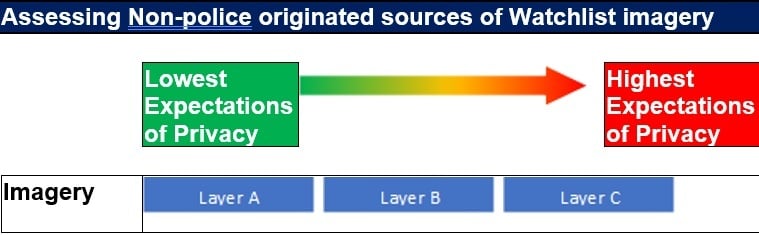
| Image layer | Outline |
|---|---|
| Non-police originated image–Layer A | Non-police originated images where it is assessed that the public would expect the law enforcement to have access to them (but not including images obtained by covert means) with examples of criteria including:
|
| Non-police originated image–Layer B |
Images where it is assessed that they raise elevated expectations of privacy or where otherwise obtained covertly without the knowledge of the subject, including any imagery obtained pursuant to:
Where the ability of relevant bodies to obtain such images is further supported and can be anticipated by reference to published Codes of Practice. |
| Non-police originated image–Layer C |
Non-police originated images in circumstances where it is assessed that the public would not typically expect their image to be shared to, or accessed by the police at the point they provided it but there is nevertheless a lawful basis for the police to hold the imagery it has received. |
3.30 Any non-police originated image should only be included in a Watchlist with the authorisation of the AO where the necessity case is made out. The AO should consider all the circumstances relating to the image, including the layer of intrusiveness attributable to it and any relevant legal, privacy, operational or safeguarding factors. The AO may consult with the relevant Chief Officer in accordance with 3.5.8.
3.31 The types of non-police originated images that may be deemed appropriate for inclusion within an LFR watchlist are of people:
- wanted by the courts; and/or
- suspected of having committed, or where there are reasonable grounds to suspect that the individual depicted is about to commit an offence or where there are reasonable grounds to suspect an individual depicted to be committing an offence; and/or
- subject to bail conditions, court order or other restrictions that would be breached if they were at the location at the time of the Deployment; and/or
- missing persons assessed as presenting an increased risk; and/or
- presenting a risk of harm to themselves or others; and/or
- who are a victim of an offence, a person who the police have reasonable grounds to suspect that person would have information of importance and relevance to progress an investigation or is otherwise a close associate of an individual and that individual themselves would fall within paragraphs (a) – (d).
- Reference images may be sourced from Athena, the missing person database (COMPACT), or images provided by members of the public with consent. Images provided with consent will often relate to missing people, but may also relate to serious crime investigations such as kidnap.
3.32 Kent Police and Essex Police LFR Documents
For each authorised LFR operation, the following assessments need to be created, reviewed, and amended where necessary by the relevant force: -
- Data Protection Impact Assessment* (Review/Amend/Adopt) *; and
- Equality Impact Assessment* (Review/Amend/Adopt) *; and
- Community Impact Assessment* (Review/Amend/Adopt) *; and
- The Surveillance Camera Commissioner’s Self-Assessment* (Review/Amend/Adopt) *;
Note: *Any assessment listed above showing `Review/Amend/Adopt’ has already been created by the relevant LFR team. Each will require a case-by-case consideration to ensure the document remains appropriate and sufficient for each LFR operation.
3.33 Management of Risk and Resources Levels
3.34.1 Each Deployment should be risk assessed in line with the relevant Kent Police or Essex Police procedure. The anticipated risk to officers and the public should be balanced against the overall intelligence picture, relevant factors linked to persons included on the Watchlist, the physical environment surrounding the Deployment, timing, community tension and any other relevant factors.
3.34.2 The level of resources, including back-up contingencies, required to support each Deployment is a matter to be determined by the operation’s command team.
3.34.3 Given the level of intrusion linked to the use of LFR for members of the public passing through the Zone of Recognition, and the processing of biometric data, it is vital that the command team ensure that sufficient resources are available to respond effectively to Alerts and to meet the law enforcement purpose of the LFR Deployment.
3.34.4 LFR System Engineers will be deployed to support LFR Deployments where required.
3.34.5 All Kent Police and Essex Police officers and staff deployed on LFR Deployments must be compliant and in date with relevant first aid and, where applicable, officer safety training requirements. All officers and staff involved in an LFR Deployment must receive LFR training prior to deployment, unless they have received comparable training delivered by another UK police force.
3.34.6 As part of the application process, the applicant should consult with the relevant force LFR team and/or Covert Authority Bureau, as applicable, to determine the appropriateness and viability of a deployment. This should be done before the application is submitted to the AO.
3.35 Cameras and camera placement
3.35.1 Cameras must be selected so that the image resolution, framerate, field-of-view and low-level light performance can provide images of sufficient quality for use in the facial recognition application. Current FR systems typically require a facial image with no less than 100 pixels between the centres of the subject’s eyes (Inter-Eye Distance or IED). The FR vendor should advise on specific requirements for their system.
3.35.2 Unless the environment is well controlled, cameras must be capable of operating at Wide Dynamic Range in order to generate high quality images under a variety of lighting conditions.
3.35.3 Cameras should ideally be positioned to capture faces as close as possible to the ‘face-on’ condition, similar to a passport image. This typically requires the cameras to be much lower than is normally the case for existing CCTV. Camera placement and angle should be further considered where those sought may be more likely to be occluded in a busy crowd in order to maximise the prospects of location.
3.35.4 Ideally the environment should be managed such that every face is evenly illuminated. Highly directional lighting, for example strong sunlight, should be avoided, which may require consideration of how the lighting will change throughout the day.
3.35.5 In general, the Zone of Recognition will be smaller than the field of view of the camera; for example, not all faces in the field of view may be in focus and not every face in the field of view will be imaged with the minimum necessary Inter-Eye Distance (IED).
3.35.6 A typical 2MP camera will provide sufficient resolution for LFR to work on a maximum of 3 to 4 people side by side. Therefore, consideration needs to be given to camera location and the physical environment. For example, looking for opportunities to funnel or restrict the movement of people within the Zone of Recognition. However, if the flow is reduced beyond a certain level, individuals may be grouped very close together, occluding or partly occluding the faces of people (people behind people).
3.35.7 Detection and processing of faces is an intensive task for a computer system. The supplier of LFR software should provide guidance on hardware requirements and the number of faces that can be simultaneously processed from within a single frame. If the system is set to process too many faces, this will potentially result in delays to the LFR system response. It may also result in missed Alerts due to ‘dropped frames’ where the software skips some of the video footage in an attempt to catch up.
3.36 LFR operational roles
LFR Command Team
3.36.1 LFR Deployments must be supported with a clear command structure. The following roles are defined for the purpose of creating an appropriate hierarchical command structure: -
- Gold Commander (Superintendent or above); There is only one Gold Commander for any LFR Deployment. Gold has strategic command of the operation and must ensure that their `strategic intention’ aligns with the Written Authority Document. Gold maintains overall responsibility for ensuring that the use of LFR remains lawful, necessary and proportionate. Gold will also liaise as necessary with NPCC ranked officers. Gold can also perform the AO role.
- Silver Commander (Chief Inspector or above); There is only one Silver Commander for any LFR Deployment. Silver reports to Gold. Silver has tactical command of the Deployment and is responsible for tactical implementation. This officer has absolute authority to suspend or terminate the Deployment at their discretion. They are also responsible for ensuring that the use of LFR and their tactical implementation remains lawful, necessary and proportionate throughout the duration of the Deployment, having particular regard to the effectiveness of the safeguards in place whilst LFR is being used.
- Bronze Commander (Sergeant or above); Bronze Commanders are assigned operational command responsibilities by Silver. Bronze Commanders report to Silver. Bronze Commanders should be present at Deployment locations unless otherwise directed by Silver. There may be more than one Bronze Commander subject to requirements set by Silver. Where this is the case, Silver must document command responsibilities and protocols with sufficient clarity and ensure that they are fully understood by all officers and staff involved in the Deployment.
3.36.2 Where LFR Deployments form part of a larger overarching policing operation, the terms Gold, Silver and Bronze (as described above) may be substituted for alternative command team terminology or be subsumed into a larger command structure as necessary and appropriate for the effective delivery of the overarching policing operation.
3.37 LFR operator
3.37.1 LFR Operators receive detailed training prior to being deployed operationally. Their role is to monitor and assess application Alerts, before working with LFR Engagement Officers (as necessary) to decide whether an Engagement is required.
3.37.2 The LFR Operator must log all Alerts to help facilitate and support command team reviews during the Deployment, and those that take place post-Deployment. The LFR Operator must flag any concerns they have regarding LFR System performance to the Silver Commander.
3.37.3 The LFR Operator’s log should include: -
- The LFR Operator’s assessment of each Alert as part of their assistance to the Engagement Officer when Adjudicating over Alerts prior to making any decision to Engage; and
- what decision was taken regarding whether to Engage a member of the public or not; and
- whether an Engagement was successfully undertaken, and the outcome of the Engagement.
3.38 LFR Engagement Officer
3.38.1 LFR Engagement Officers must have an understanding of the LFR application, how it performs, and what effect Subject, System, and Environmental Factors might have. These officers must receive a full operational briefing prior to deployment. These officers will be deployed in uniform.
3.38.2 When conducting an Engagement, LFR Engagement Officers must ensure that they do so lawfully, and in an appropriate and proportionate manner. Officers must comply with the Code of Ethics at all times. Wherever possible, members of the public who have been subject of an Engagement, should be supplied with an LFR information leaflet.
3.38.3 The LFR Operator may be supportive of an engagement taking place, but in any case, it is always for an LFR Engagement Officer to make their own final decision on whether an Engagement should take place. It must not be an automatic consequence that an Alert results in an Engagement. In making their decisions, LFR Engagement Officers must give due regard to the likelihood of Subject, System, or Environmental Factors influencing the generation of an Alert.
3.38.4 When an engagement is initiated, it is for the officers involved to investigate the identity of the person engaged using appropriate and lawful means at their disposal. There is a four-stage process leading to an appropriate outcome.
STAGE 1 – LFR software alerts to a potential match on the watchlist. LFR operator will visually assess the two images and only notify an engagement officer if they believe the match is correct.
STAGE 2 – Engagement officer will approach the individual and confirm their identity via personal documentation or fingerprint device if appropriate.
STAGE 3 – Engagement officer will then assess and decide on the appropriate form of disposal.
STAGE 4 – If an arrest takes place, then the appropriate custody department and the officer in the case will be notified.
3.38.5 An alert generated by the LFR system does not establish identity, reasonable suspicion or grounds for arrest. Any engagement, stop, search, arrest or other operational action must be based on a lawful and independent assessment by officers, taking account of all available information and relevant powers. Officers must always seek to make sufficient additional enquiries to satisfy themselves of their grounds to arrest or detain. Where confronted with a non-compliant subject, and the circumstances are such that an officer has an honestly held belief they must use their powers of arrest or detention before further checks have been possible, further checks must be made as soon as reasonably practicable so that the decision is reviewed without unnecessary delay.
3.38.6 If an ‘Engaged Individual’ cannot be identified or fails to confirm their identity, this alone does not constitute a criminal offence and does not necessarily render them liable to arrest. Officers must be in a position to justify the use of any powers, any action taken, and have a lawful basis for doing so.
3.38.7 After any Engagement (that follows an Alert), the LFR Engagement Officer must update the LFR Operator with the outcome of that Engagement.
3.38.8 Where members of the public choose to exercise their right to avoid an LFR Zone of Recognition, officers are reminded that this is not an offence. The police have no legal powers to direct or compel members of the public to enter a Zone of Recognition. None of this means that LFR Engagement Officers, or other officers involved in an ancillary role linked to an LFR Deployment, cannot or should not engage with a member of the public as they would do in any other set of circumstances where someone’s behaviour or presence gives rise to suspicion or the use of any other policing power where it is right and proper to do so. If other lawful orders are in existence where there is a requirement to remove face coverings (i.e. Sec 60) then the silver commander will direct officers deployed accordingly in line with the legal direction. There are no common powers to require someone to remove a face covering outside specific legislation.
3.39 LFR System Engineers
3.39.1 LFR System Engineers have enhanced technical training for the Deployment of LFR, see Kent Police and Essex Police LFR Policy Document for further information. LFR System Engineers are responsible for the set-up of the LFR equipment and the optimisation of the LFR application to maximise performance.
3.40 Public Engagement
3.40.1 Public engagement must be supported using online resources available to the public, which should be underpinned by a press and media strategy giving advance notice of deployments. At and around the location of deployments, notices providing information, including details of the Privacy Notice, should be distributed and feedback via email should be sought.
3.40.2 Operational briefings delivered to officers and stakeholders prior to deployments should promote openness with the public and transparency about the use of LFR. Officers should be encouraged to engage with the public to increase awareness of how LFR helps keep the public safe and how it helps bring offenders to justice. It is also helpful for officers to be in possession of information leaflets that can be handed out to the public. Such information leaflets should deliver important key messages aimed at promoting trust and confidence through improved understanding.
3.40.3 Key stakeholders, including the PCC’s Office, may be invited to observe the planning and deployment of LFR although it must be noted that the deployment is an operational matter.
3.40.4 In advance of deployments Kent Police and Essex Police will ensure that:
- LFR Deployments are notified to the public using Kent Police and Essex Police websites and other appropriate communication channels, including social media; and
- LFR awareness raising measures, such as signs and/or leaflets, are prepared to support LFR deployment in line with the Kent Police and Essex Police LFR SOP; and
- literature is prepared for persons who may be engaged (to include information outlined within a privacy notice); and
- Officers are briefed on their powers and the limits thereof. In particular, it must be made clear that there is no power to require an individual’s cooperation in having their image captured, unless either the threshold for arrest has been reached, or an Inspector or above has authorised the exercise of the power under section 60AA of the Criminal Justice and Public Order Act 1994 for a Constable in uniform to compel a person to remove anything that conceals their identity; and
- External engagement is considered in discussion with the relevant Kent Police or Essex Police LFR team. It may be appropriate to pursue engagement opportunities with several stakeholders, including local authorities, and public consultative or ethical review bodies. It is important that engagement is coordinated and so the relevant LFR team must be consulted prior to this kind of activity.
3.40.5 During deployments Kent Police and Essex Police will ensure that:
- awareness raising measures are used in line with the Kent Police and Essex Police LFR SOP to ensure that the policing presence is overt such that the public can establish that LFR is being used and understand the nature of the data being processed; and
- notices with a brief explanation and reference to Kent Police and Essex Police websites are available to hand out to the public on request; and
- information is offered to persons engaged by officers in accordance with the policy referred to above.
3.40.6 After deployments Kent Police and Essex Police ensure that:
- information about the deployment, including location, time, date, number of alerts, engagements, arrests, and any other information considered helpful and suitable for disclosure, is published on Kent Police and Essex Police websites. Care must be taken to ensure that no personal data is published;
- external engagement is considered in discussion with the relevant Kent Police or Essex Police LFR team. Again, it may be appropriate to pursue engagement opportunities with several stakeholders, including local authorities, and public consultative or ethical review bodies. It is important that the engagement is coordinated and so the relevant LFR team must be consulted prior to this kind of activity; and
- engagement with representatives from the Information Commissioners Office will be ongoing.
3.40.7 Post-Deployment
- Following each LFR Deployment, the Silver Commander must ensure that a post Deployment evaluation is completed which is updated in the Deployment Record. The evaluation process must capture an assessment of the operational effectiveness of the LFR Deployment. This evaluation should be both qualitative and quantitative in nature.
- The evaluation should clearly articulate what measures are used to assess effectiveness and what benchmarking criteria are used. It should also assess the effectiveness of the safeguards used for the Deployment and what opportunities exist to improve them for future use, and how learning will be shared.
The evaluation may include as many measures as appear appropriate, but as a minimum must include the following metrics (including what methods were used to obtain them): -
- total number of individuals and the total number of images included in the Watchlist (there may be multiple images of some individuals); and
- total number of facial images detected in the video stream that were of sufficient quality for searching against the Watchlist (i.e. the LFR application was able to generate a Template from them); and
- total number of LFR application-generated Alerts; and
- total number of Alerts that do not result in an Engagement; and
- total number of Alerts where a decision was taken to Engage an individual; and
- total number of Alerts that are confirmed as true alert (the individual is who the LFR application suggests are); and
- total number of Alerts that are confirmed as a false alert (the individual is not who the LFR application suggests they are); and
- total number of correct Alerts that result in an Engagement that do not require any further police action; and
- outcome of each case where police action is instigated following an Alert; and
- number of people Engaged, where the Engagement was not the result of Alert, including the reasons and outcome; and
- Threshold setting for the Deployment.
- OPC complete the alerts spreadsheet which includes full details of the individual including their age, sex and ethnicity. The outcome of the alert i.e. arrest and the disposal.
3.41 LFR Application Security
3.41.1 The LFR application, associated equipment and deployment data must be protected by appropriate physical, technical, access-control, audit and data-security arrangements approved by the relevant force. Detailed technical security arrangements must not be published in this procedure where disclosure could undermine operational or information security.
3.41.2 Any loss, theft, compromise or suspected compromise of LFR hardware, software, removable media, access credentials or deployment data must be reported immediately to the AO, Gold Commander and the relevant Data Protection Officer, and managed in accordance with force information-security and data-breach procedures.
3.42 Data Retention and Data Management
3.42.1 Kent Police and Essex Police must ensure that the processing of any data associated with LFR is conducted lawfully and in compliance with the Kent Police and Essex Police LFR documents. This means that: -
- where the LFR application does not generate an Alert, that a person’s biometric data is immediately automatically deleted; and
- live operational watchlist data and any medium used to import the Watchlist must be deleted as soon as practicable, and in any case within 24 hours following the conclusion of the Deployment.
3.42.2 The audit record, search rationale, decision-making material used to compile the Watchlist, deployment logs and records required for scrutiny, review, complaints, disclosure or legal challenge will be retained securely in accordance with MOPI, CPIA, data protection requirements and relevant force retention policies. Any personal data retained for evaluation, complaint, conduct, disclosure or legal purposes must be documented, justified and retained only for as long as necessary.
3.42.3 All CCTV footage generated from LFR Deployments is deleted within 31 days, except where retained: -
- in accordance with the Data Protection Act 2018, MOPI and the Criminal Procedures and Investigations Act 1996; and /or
- in accordance with Kent Police and Essex Police complaints / conduct investigation policies.
3.42.4 To support compliance the LFR application has a full audit capability, and the LFR Operator and LFR Engagement Officer log is retained in line with MOPI retention periods.
3.42.5 The loss or theft of any LFR hardware, including a laptop, mobile device or camera, or other data, irrespective of whether protected by encryption, must be reported immediately to the AO, Gold, and the relevant Kent Police or Essex Police Data Protection Officer.
3.43 Register of Deployments
3.43.1 Any Deployment of LFR must be recorded on a centrally held register. This register will record a number of things including: -
- Name and rank of the AO and command team; and
- Date, time, duration, and locality of Deployment; and
- Watchlist composition statistics (not including any personal data); and
- The number of Alerts and the various statistics relating to these; and
- Number of Engagements and their results.
3.43.2 Kent Police and Essex Police will make information relating to LFR Deployments available to the public in accordance with the Kent Police and Essex Police LFR Documents.
3.44 Contact Information
3.44.1 The relevant Kent Police or Essex Police LFR team should be contacted for deployment advice, operational support and governance enquiries.
3.45 Governance & Oversight
3.45.1 The following stipulations are accepted by Kent Police and Essex Police:
- The overall benefits to the public must be balanced with public confidence of our use of LFR.
- It can be evidenced that the technology itself will not result in unacceptable gender or racial accuracy variance into policing operations.
- Each deployment must be appropriately assessed and authorised, demonstrating both necessary and proportionate for a specific policing purpose.
- LFR operators are trained to understand the risks associated with use of the LFR application, including how potential injustices may be caused through inappropriate responses, and that they are accountable for their actions.
- Kent Police and Essex Police will develop and maintain robust governance and oversight arrangements that balance the technological benefits of LFR with its potential intrusiveness. These arrangements will meet national requirements for transparency, whilst considering guidance from relevant regulators and national policing bodies. The arrangements will also focus on implementing a transparent and visible internal inspection, audit and compliance enforcement regime.
- A quarterly review of the positive alerts will take place analysing the performance of the deployments and the analysis of the special characteristics of the individuals subject to alert i.e. a breakdown of age, gender, ethnicity together with arrest and disposal outcomes.
3.45.2 Governance and oversight of the use of the technology is approached in the three stages below:
- Pre-deployment
- Operational deployment
Post-deployment
3.45.3 Pre-deployment:
- Authority to deploy LFR is an operational one, where the Authorising Officer (AO) rank is set at Superintendent. In exceptional cases of urgency, an officer below the rank of Superintendent, but not below the rank of Inspector, may authorise the deployment of LFR.
- Where an officer below the rank of Superintendent provides the authority, a Superintendent must be informed as soon as practicable. It is for the Superintendent to then authorise the deployment to continue, making changes to the authority where they believe necessary, or direct that it must stop.
- Prior to AO authorisation and the deployment of LFR in public spaces, several documents must be completed and the relevant Chief Officer lead for Kent Police or Essex Police must be made aware by the AO. Whilst the Chief Officer does not provide authority for LFR deployment, consultation at this level exists to expose the proposed deployment to an elevated level of strategic thinking in line with the circumstances described at 3.5.8, whereby issues are considered as much as possible. This affords the Chief Officer the opportunity to scrutinise the deployment and to ask the AO to consider what mitigation is required to address concerns at hand.
- Several specific Essex Police documents and records need to be completed in support of each deployment. These are set out below:
Kent Police and Essex Police LFR Deployment Specific Documents and Records
| LFR application | Sets out the details of a proposed deployment including location, dates/times, legitimate aim, legal basis, necessity, proportionality, safeguards, Watchlist composition, and resources. |
| Written Authority Document |
The AO’s written authority provides a decision-making audit trail demonstrating how the AO has considered the legality, necessity and proportionality of the deployment of LFR, the safeguards that apply and the alternatives that were considered but deemed to be less viable to realise the policing purpose. The written authority also details the arrangements that have been made to manage the retention and/or disposal of any personal data obtained because of the LFR Deployment. The written approval must be retained in accordance with MOPI and other relevant legislation or policy and be made available for independent inspection and review as required. |
| LFR deployment record | Records details of where and when a deployment was carried out, what resources were used, relevant statistics, outcomes and summary of any issues. |
| Assessments |
These include the Community Impact Assessment, the Equality Impact Assessment, the Data Protection Impact Assessment, and the Surveillance Camera Commissioner’s Self-Assessment. These documents need to be considered by the decision-maker when authoring a deployment to ensure they are sufficient to address the issues arising from the proposed deployment. The decision-maker must ensure that issues have been adequately identified, documented, and mitigated by way of safeguards such that the deployment is not only necessary, but also proportionate to the policing purpose. |
| Deployment logs | Logs completed in the planning and execution of an LFR deployment. For example, logs completed by the Gold and Silver Commanders, LFR Operators and LFR Engagement Officers. |
3.46 Several other specific Kent Police and Essex Police documents pertaining to each LFR deployment have been completed centrally. These are set out below:
Kent Police and Essex Police LFR Documents and Records
| Kent Police and Essex Police Data Processing – Appropriate Policy Documents Documents |
Kent Police and Essex Police policy on the processing of data pursuant to the Data Protection Act 2018 and UK General Data Protection Regulation relating to LFR. |
| Kent Police and Essex Police Legal Mandate | Outlines the legal considerations to be addressed to use LFR. |
| Kent Police and Essex Police Training | Provides the necessary training to ensure those involved in authorising and deploying LFR are familiar and implement the considerations relevant to its lawful, ethical and appropriate use. |
3.47 Oversight bodies and Regulatory Framework
3.47.1 Within Kent Police and Essex Police, senior internal oversight for LFR will be provided through the relevant force governance arrangements. External oversight and scrutiny may also be provided through the relevant Police and Crime Commissioner’s Office.
3.47.2 The Kent Police and Essex Police LFR Legal Mandate sets out the legal framework for the use of LFR technology, whilst the LFR Policy Document and this procedure document support implementation. The legal framework includes relevant case law, including Bridges and R (Thompson and Carlo) v Commissioner of Police of the Metropolis [2026] EWHC 915 (Admin), which confirms the importance of clear, foreseeable and constrained policies with appropriate safeguards and oversight.
3.47.3 Nationally, the `NPCC Facial Recognition Technology Board’ provides oversight for the operational uses of facial recognition within UK Law Enforcement.
3.47.4 Further oversight opportunities may arise in relation to the `Joint National Biometric Strategic Board’. This is co-chaired by the NPCC and the Home Office Data and Identity Department, and involves representatives of the Information Commissioners Office, the Surveillance Camera Commissioner, the Biometric Commissioner and the Essex Data Ethics Committee. More detail on these roles:
- Surveillance Camera Commissioner (SCC); The role of the Surveillance Camera Commissioner is to encourage compliance with the surveillance camera code of practice, review how the code is working, provide advice to ministers on whether the code required amendment. Any Kent Police or Essex Police LFR system will need to comply with this Code and the twelve guiding principles. This guidance document seeks to apply those principles. See www.gov.uk/government/organisations/surveillance-camera-commissioner
- Biometrics Commissioner (BC); The Commissioner is independent of Government and aims to keep the police use and retention of biometric data under review. The Commissioner makes decisions on applications made by the police to retain DNA profiles and fingerprints, and reviews national security determinations that are made or renewed by the Police in connection with the retention of DNA profiles and fingerprints. The Commissioner also reports to the Home Secretary about the carrying out of their functions. See: www.gov.uk/government/organisations/biometrics-commissioner
- Information Commissioner’s Office (ICO); The ICO upholds information rights in the public interest, promoting openness by public bodies and data privacy for individuals. The Data Protection Impact Assessment must comply with Sections 35 – 40, (Principles 1 – 6) and Section 64 Data Protection Act 2018 and should be shared with the ICO. See www.gov.uk/government/organisations/information-commissioners-office
- Relevant ethics and scrutiny bodies may provide independent advice and oversight to Kent Police and Essex Police on ethical matters, including the promotion of ethical considerations within a legal and regulatory framework.
4. Equality Impact Assessment (EIA)
EIA - September 2026.
5. Risk assessment
5.1 Each Deployment should be risk assessed in line with the relevant Kent Police or Essex Police procedure. The anticipated risk to officers and the public should be balanced against the overall intelligence picture, relevant factors linked to persons included on the Watchlist, the physical environment surrounding the Deployment, timing, community tension and any other factors that appear relevant.
5.2 The level of resources, including back-up contingencies, required to support each Deployment is a matter to be determined by the operation’s command team.
5.3 Given the level of intrusion linked to the use of LFR for members of the public passing through the Zone of Recognition, and the processing of biometric data, it is vital that the command team ensure that sufficient resources are available to respond effectively to Alerts and to meet the law enforcement purpose of the LFR Deployment.
5.4 LFR System Engineers will be deployed to support LFR Deployments where required.
5.5 All Kent Police and Essex Police officers and staff deployed on LFR Deployments must be compliant and in date with relevant first aid and, where applicable, officer safety training requirements. All officers and staff involved in an LFR Deployment must receive LFR training prior to being deployed.
6. Consultation
6.1 The following internal and external stakeholders should be consulted during the formulation, approval and review of this document:
- Unison
- Police Federation
- Essex Diversity and Inclusion Team
- Health & Safety
- Head of Operational Change
- PSD D/Superintendent
- Risk
- Policy
- Superintendents Association
- Strategic Force Crime & Incident Registrar
- DPO/Temp Head of Info Management
- Head of Operational HR
- Support Network Chairs and Vice Chairs
- Specials Command Essex
- Essex Diversity and Inclusion Team
- Head of Continuous Improvement
- Head of the Control Centre
- Legal
- Kent Force Independent Advisory Group (IAG)
7. Monitoring and review
7.1 Kent Police and Essex Police will carry out intermittent reviews for legislative, regulatory or process changes and will carry out yearly reviews of the whole document.
8. Governing force policy
Related force police or related procedures
8.1 Data Security
8.1.1 Kent Police and Essex Police have measures in place to protect the security of data in accordance with their respective Information Management policies.
8.2 Retention & Disposal of Records
8.2.1 Kent Police and Essex Police will hold data in accordance with their respective records review, retention and disposal policies.
8.2.2 Data will only be held for as long as necessary for the purposes for which it was collected. Victims and members of the public should be reminded that Kent Police and Essex Police take the protection of personal data seriously as described in their respective privacy notices.
9. Other source documents, e.g. legislation, APP, partnership agreements (if applicable)
9.1 Further documentation is available providing useful information relevant to LFR. This is detailed below.
- Information Management APP; https://www.college.police.uk/app/information-management
- National Decision Model; National decision model | College of Policing
- National Intelligence Management; Intelligence management | College of Policing
- College of Policing Code of Ethics
- Home Office Biometric Strategy – Published June 2018; www.gov.uk/government/publications/home-office-biometrics-strategy
- High Court Ruling – R (on the application of Edward Bridges) v The Chief Constable of South Wales [2019] EWHC 2341 (Admin)
Policy reference: Live Facial Recognition (LFR) processes (S5101)
Contact point: Head of SCD
Date last reviewed: September 2026
For general enquiries, contact us.